
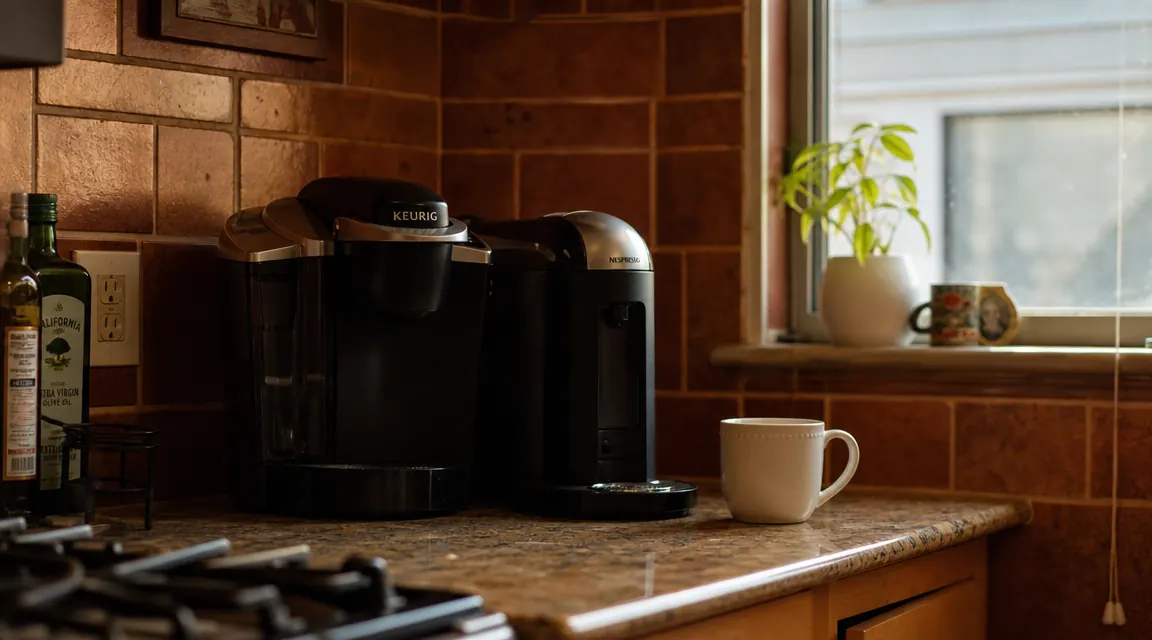
Here is the short answer: if you have a small counter and you want a reliable cup of coffee every morning without fussing, the Keurig K-Mini is the better buy. It is five inches wide, brews in under two minutes, works with any K-Cup pod, and has a cord storage slot in the back so it looks tidy on a narrow counter. The Hamilton Beach FlexBrew Single-Serve does more on paper, including a pod-free ground-coffee option, but it is noticeably bulkier and the versatility comes at a cost to the one thing that matters most in a small kitchen: space.
I have had a Keurig K-Mini sitting on my five-inch counter strip next to the sink for the better part of a year now. Before that I tried two other machines in the same footprint category. The Hamilton Beach FlexBrew was one of them. Both have their place, and I will tell you honestly where each one wins before giving you my pick.
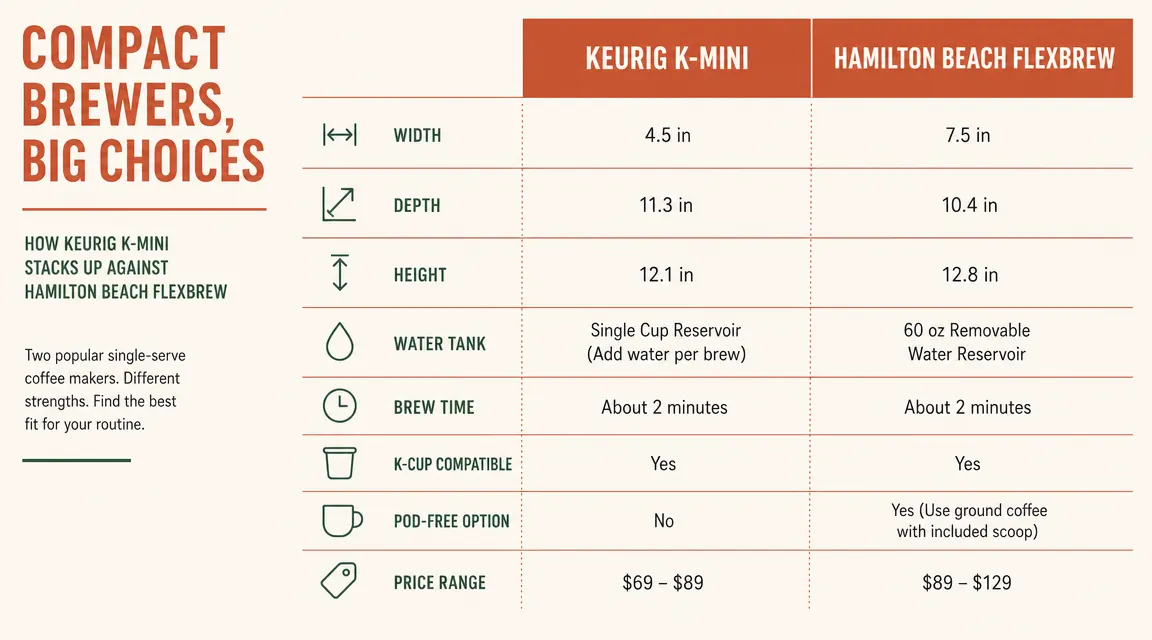
| Feature | Keurig K-Mini | Hamilton Beach FlexBrew Single-Serve |
|---|---|---|
| Width | 5 inches | 7.5 inches |
| Depth | 11.3 inches | 10.8 inches |
| Height | 12.1 inches | 12.4 inches |
| Water tank | Fill per cup (6-12 oz) | Removable 16 oz reservoir |
| Brew time (12 oz) | Under 2 minutes | Approx. 3 minutes |
| K-Cup compatible | Yes | Yes |
| Ground coffee option | No (reusable pod sold separately) | Yes (built-in pod-free basket) |
| Cord storage | Yes (built in) | No |
| Amazon rating | 4.3 stars (107,748 reviews) | 4.4 stars (~34,000 reviews) |
| Current price | See today's price on Amazon | Not available here |
Your counter has five inches. The K-Mini fits in five inches.
The Keurig K-Mini has 107,748 Amazon reviews and brews a 6 to 12 oz cup in under two minutes. If counter space is the constraint, this is the one that solves it.
Amazon Check Today's Price on Amazon →Where the Keurig K-Mini Wins
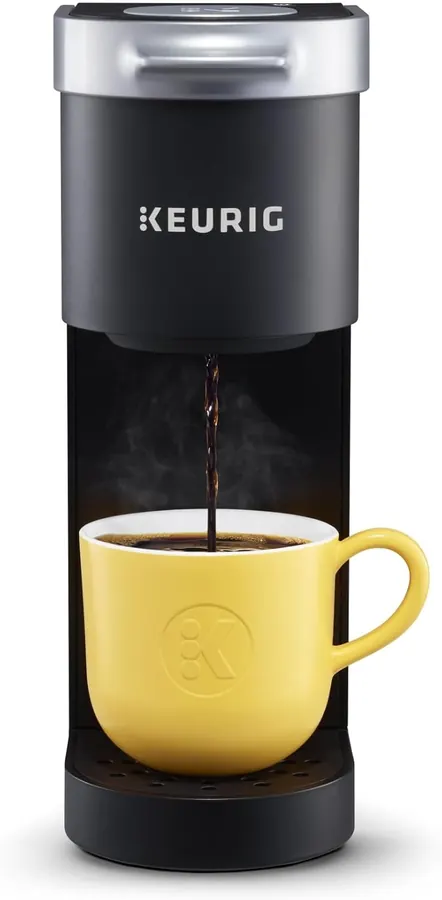
The K-Mini is genuinely five inches wide. I know that sounds like marketing copy, but I measured it myself with a tape measure on my counter and it clocks in at just a hair over five inches at the widest point. That is narrower than a standard coffee mug is tall. In a galley kitchen or an apartment with two feet of usable counter space, that difference between five inches and seven and a half inches is meaningful.
Brew speed matters in a small kitchen too, because small kitchens usually mean smaller apartments and smaller apartments usually mean mornings where you are getting ready in the kitchen and the bathroom at the same time. The K-Mini heats from cold to brewed in under two minutes. I have timed it many times. On a 12 oz brew I typically see it finish in about a minute forty-five. You press the button, go brush your teeth, come back to a full cup.
The cord storage is a small thing that I did not expect to care about, but I do. There is a little channel on the back of the machine where you tuck the excess cord. It keeps the counter looking neat without having to stuff the cord behind something or let it dangle over the edge. In a small kitchen, visual clutter is its own kind of stress.
Cleanup is also very simple. There is no carafe to wash, no filter basket to rinse, no pod tray that traps coffee residue. You drop in a K-Cup, brew, pull out the pod, and you are done. The drip tray lifts out and rinses under the faucet in about thirty seconds. I clean the whole machine in under a minute.
Where the Hamilton Beach FlexBrew Single-Serve Wins
The Hamilton Beach FlexBrew does something the K-Mini cannot do out of the box: it brews from ground coffee using a built-in pod-free basket. If you care about buying your own beans and grinding them yourself, or if you want to use any standard pod or soft pad rather than being tied to K-Cup format, the FlexBrew gives you that flexibility. For some people that is a genuine priority, and I do not want to brush past it.
The FlexBrew also has a removable reservoir that holds 16 ounces, which means if you want to brew two cups back to back you do not have to refill between cups the way you do with the K-Mini. The K-Mini is a fill-per-cup machine, meaning you pour water in for each brew. Most people do not find this annoying, but if you have a partner or roommate who also wants coffee in the same window of time, the FlexBrew handles that slightly more gracefully.
The question I always ask about a kitchen appliance is not 'What can it do?' but 'What does it cost me in counter inches to have it here?' The K-Mini answers that question better than almost anything else I have used.
The FlexBrew also tends to run a little cooler in temperature by the time the cup reaches your hands, which some people actually prefer. If you find K-Cup coffee tends to come out scalding, the FlexBrew may feel better to drink sooner. That is a minor point but worth naming for people who are particular about serving temperature.
The Counter Space Reality
I want to spend a moment on the size difference because I think it gets underplayed in most comparisons. Two and a half inches of width does not sound like much. But most apartment counters have one or two real appliance slots. My counter has room for three things comfortably: the K-Mini, my toaster, and a small cutting board. If I swapped the K-Mini for the FlexBrew, I would lose most of that cutting board space. That is not a hypothetical, that is what happened the three weeks I was testing the FlexBrew. I ended up prepping food on the kitchen table because the counter was too tight.
The K-Mini also has a taller, more vertical profile than it looks in product photos, but it tucks under most standard upper cabinets without issue. I have about 18 inches of clearance between my counter and upper cabinet, and the K-Mini fits with several inches to spare. The FlexBrew has a similar height, so neither one wins on vertical space.
If you are in an RV or a dorm room where the only available surface is a small shelf or a bedside table, the K-Mini is the machine that actually fits. The FlexBrew is still a compact machine by most standards, but it is a different tier of compactness.

Pod Cost and Coffee Quality
This is the one area where I want to give a fair accounting of both machines. K-Cup pods cost more per cup than ground coffee, sometimes significantly more depending on the brand you choose. If you brew two cups a day and buy mid-tier K-Cups, you are probably spending somewhere between twenty-five and forty dollars a month on pods. If you use the FlexBrew's ground coffee basket and buy beans in bulk, you can cut that to eight or ten dollars a month. For some budgets, that math matters.
That said, you can use a reusable K-Cup pod with the K-Mini. Keurig sells one, and there are third-party versions for a few dollars. Fill it with your own ground coffee, brew it, rinse it out. It is not as quick as popping in a fresh pod, but it works. I have done it when I ran out of pods. The reusable pod produces a slightly weaker cup at the 12 oz setting, so I brew at 8 or 10 oz if I am using ground coffee in it.
As for coffee quality, neither machine is going to produce a cafe-caliber cup. Both heat water quickly and run it through the grounds at roughly the right temperature. The K-Mini at the 6 oz setting produces a noticeably stronger cup than at 12 oz, which is the standard advice for getting good flavor out of any K-Cup. The FlexBrew at its pod setting is comparable. The flavor difference between the two machines is small enough that the coffee brand and pod type you choose matters far more than which brewer you use.
Who Should Buy Which
Buy the Keurig K-Mini if counter space is your first concern, you are mostly making one cup at a time, you want a fast morning routine, and you are fine with K-Cup pods or picking up a reusable pod. It is the right machine for the vast majority of small-kitchen coffee drinkers. The 107,748 Amazon reviews are not there by accident. It is a simple machine that does its job well and gets out of the way.
Consider the Hamilton Beach FlexBrew if you are particular about using your own ground coffee and you do not want the extra step of a reusable pod, if you sometimes need to brew two cups in a row without refilling, or if the two and a half extra inches of width genuinely does not matter to your counter situation. It is a solid machine with good value for what it does, and if you find it for a lower price than the K-Mini it can make sense for the right buyer.
If you are not sure which category you fall into, I would lean toward the K-Mini. It is easier to add a reusable pod later than it is to recover two and a half inches of counter space. And if you read my long-term review of the K-Mini after six months of daily use, you will get a good sense of what living with it actually feels like day to day.
There is also a deeper look at the K-Mini's quirks in my honest review, where I cover the water reservoir reality and the brew settings that get the strongest cup. Both are worth reading before you decide.
The K-Mini fits where other coffee makers don't. That's why it earns its spot.
Over 107,000 Amazon buyers agree this is the right single-serve machine for a compact kitchen. It brews 6 to 12 oz, cleans up in under a minute, and stores its own cord. Check the current price before you decide.
Amazon Check Today's Price on Amazon →